
The Influence of Chromite Powder Quality on Green Coloring of Glass Bottles
1. Chromium Content (Cr₂O₃) in Chromite Powder Affects Color Depth and Batch Color Difference of Glass Bottles
The higher the chromium content, the deeper the green tone of glass bottles; the lower the chromium content, the lighter the green shade. Unstable Cr₂O₃ content in chromite powder will cause inconsistent color of finished glass bottles. To maintain stable bottle color, chromite powder with premium quality and steady chromium oxide content must be selected.
South African chromite powder is the most widely used material for glass bottle coloring, with a standard Cr₂O₃ content of ≥46%. This grade meets the coloring requirements for beer bottles. It does not require excessive addition and effectively avoids black speck defects.
2. Iron Content (Fe₂O₃): Determines the Warmth/Coolness of Green Tones
Iron oxide is an inherent component of chromite sand and a key auxiliary colorant for olive green. Stable iron oxide content is essential to minimize color deviation of glass bottles. Either excessively high or low iron content will alter the bottle color.
- High iron content: Strengthens yellow undertones, producing warm olive green typical of beer bottles with superior UV shielding performance.
- Low iron content: Creates cool light emerald green with weakened light-blocking capability.
Fluctuating iron content across batches results in inconsistent visual appearance, with some batches yellowish and others bluish green.
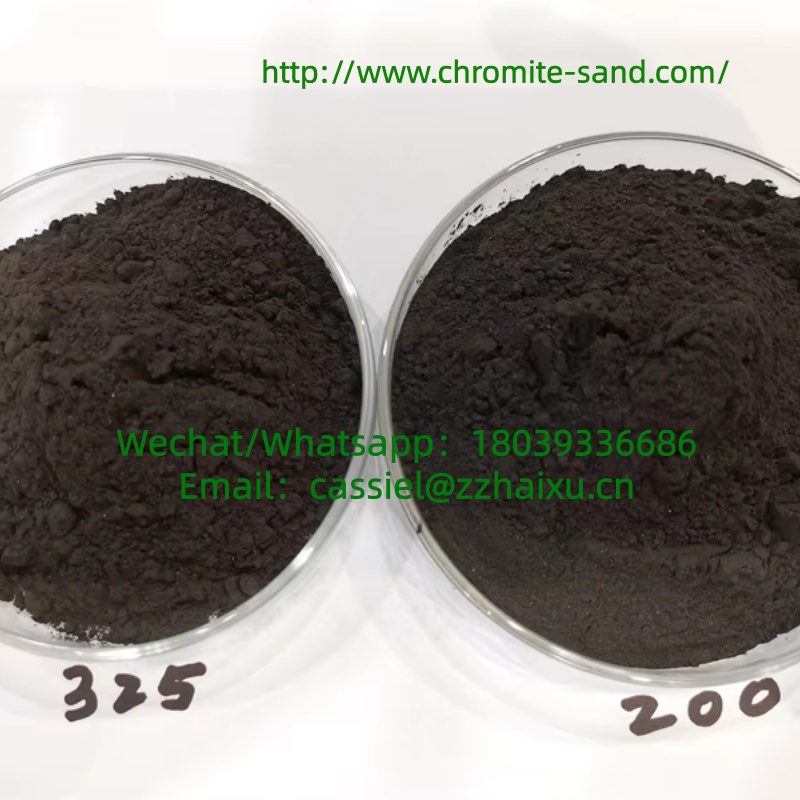
3. Particle Size (325 Mesh Standard): Directly Impacts Coloring Uniformity
For standard 325-mesh chromite powder, over 90% of particles shall pass through a 325-mesh sieve, while residue on the sieve shall not exceed 10%.
Excessive coarse residue on the 325-mesh screen will lead to black pits, color spots and hard unmelted mineral stones on bottle surfaces, resulting in rejected finished products. Coarse particles disperse poorly during raw material mixing and cause localized dark color patches.
Qualified 325-mesh chromite powder features uniform particle sizes, synchronous melting and smooth, consistent coloring. Therefore, controlling the particle size distribution of 325-mesh chromite powder is critical for stable glass bottle color.
4. Moisture Content and Caking Tendency
When moisture content exceeds 0.5%, chromite powder easily agglomerates into lumps that cannot be fully broken during mixing. This causes localized chromium enrichment in the batch mixture, leading to dark streaks and massive color spots after forming.
5. Impurity Content (SiO₂, Clay, Refractory Impurities)
- High silica and clay impurities: Generate unmelted stones, bubbles and surface pits during melting, impairing glass transparency and creating a mottled color appearance.
- Reductive impurities (carbon, sulfides): Create local reducing atmospheres inside the furnace, converting Cr³⁺ to Cr²⁺ and forming gray-blue patches that dull the base green color.
- Abnormal fluctuations of calcium and magnesium impurities: Change the viscosity of molten glass, hinder uniform diffusion of chromium ions and trigger vertical color streaks on bottles.
6. Structural Stability of Chromite Ore from Different Sources
Chromite ores from various origins differ in crystal structure and decomposition temperature.
Low-grade refractory chromite cannot fully dissociate at around 1450℃, leading to insufficient release of chromium ions, pale grayish green finished glass. High-quality chromite fully decomposes within standard glass melting temperature ranges, delivering stable, rich color tones.
7. Summary of Quality Standards for Premium 325-Mesh Chromite Powder for Glass Bottle Coloring
- Stable Cr₂O₃ content ranging from 46% to 48%, with batch fluctuation controlled within ±0.8%;
- All particles pass through 325-mesh sieve without coarse residues;
- Moisture ≤0.5%, loose and free of agglomeration;
- Low clay, free carbon and refractory impurities;
- Stable Fe₂O₃ content to guarantee consistent olive green shades.
8. Introduction to Our Chromite Powder
- Origin: South Africa
- Cr₂O₃: ≥46%
- Fe₂O₃: ≤26.5%
- SiO₂: ≤1%
Available particle sizes for glass bottle colorants: 200 mesh, 325 mesh, 400 mesh, 600 mesh, 800 mesh, 1000 mesh, 1200 mesh, 1600 mesh, 2000 mesh, 2500 mesh
chromite flour Supplier: Zhengzhou Haixu Abrasives Co., Ltd.
Contact: Cassiel wang
WhatsApp / Mobile: +86 18039336686
Email: [email protected]