
Effect of Chromite Flour Particle Size on Glass Bottle Quality
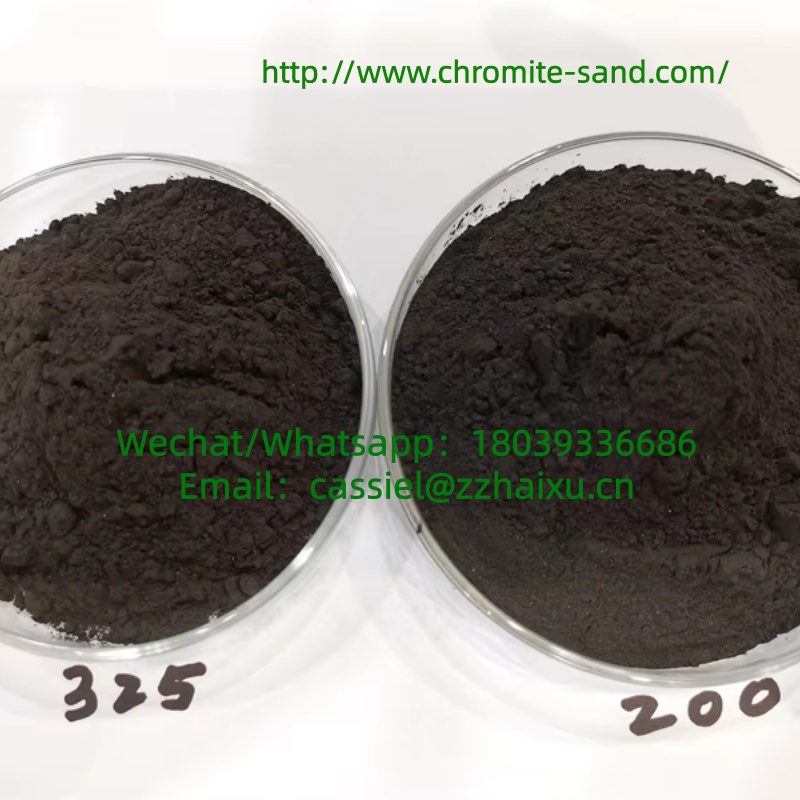
Chromite flour is categorized by particle fineness into 200 mesh, 325 mesh, 400 mesh, 600 mesh, 800 mesh, 1000 mesh, 1200 mesh, 1600 mesh, 2000 mesh and 2500 mesh. The fineness of chromite powder/chromite flour directly determines the color tone and surface appearance of glass bottles.
I. Defects Caused by Over-Coarse Chromite flour
- Black specks and granular inclusions on bottle surfaceCoarse chromite grains feature high melting points and cannot be fully melted and decomposed at the furnace temperature of around 1400°C. Undissolved chromite residues remain trapped inside glass, forming visible hard black particles and drastically increasing finished product reject rate.
- Obvious color difference and local dark patchesCoarse grains concentrate coloring effect, resulting in overly dark green areas nearby while the surrounding molten glass lacks chromium ions. This leads to uneven shade on single bottles and inconsistent color across whole production batches.
II. Moderate Particle Size (325 ~ 400 Mesh, Mainstream Grade for Glass Coloring)
- 325 mesh and 400 mesh chromite powder/flour fully melts and decomposes at 1400°C without black specks or crystalline stones;
- Good powder dispersion prevents delamination during raw material mixing, delivering consistent uniform green on glass bottles;
- Balanced grinding energy consumption and production cost, with strong tinting strength without raising addition dosage;
- Rare defects like bubbles and color mottling, fully compliant with mass production standards for beer bottles and regular green beverage bottles.
III. Pros & Cons of Ultra-Fine Chromite Powder (600 Mesh and Above)
Advantages
- Faster melting speed. Cr³⁺ ions can be fully released at relatively low temperature, creating bright and transparent green, ideal for high-end clear emerald glass bottles;
- Free of granular black spots, applicable to premium essential oil bottles and luxury fruit wine bottles;
- Higher tinting power under identical addition amount, allowing slight dosage reduction to cut raw material cost.
Disadvantages
- Severe dusting causes heavy pollution in batching workshops, high material loss and inaccurate mixing ratios;
- Large specific surface area leads to easy moisture absorption and agglomeration. Hard agglomerates will still form massive color mottling just like coarse particles;
- Higher grinding cost, so its unit price per ton is higher than 325 / 400 mesh grades;
- Slightly higher trace chromium volatilization in furnace flue gas, which may block flues and regenerators after long-term continuous operation.
IV. Indirect Influence of Particle Size on Color Depth and UV Blocking Performance
- Coarse powder: Dark, heavy color with uneven UV shielding; certain areas provide strong light barrier while others transmit excessive ultraviolet rays;
- Standard 325–400 mesh: Chromium ions distribute evenly in glass lattice to form homogeneous olive green with stable UV isolation, ensuring consistent light-proof preservation performance;
- Ultra-fine powder: Brighter and clearer color, the top choice for light green glass bottles, yet slightly weaker UV shielding capacity at the same glass thickness compared with medium-size powder.
V. Practical Grade Selection Guide for Production
- Ordinary beer bottles, sauce & vinegar bottles, mass low-cost green glass containers: 325 mesh, best cost performance and lowest defect rate;
- Mid-to-high grade beverage and fruit wine bottles requiring speck-free surface: 400 mesh;
- Luxury essential oil bottles, transparent light green decorative glass bottles: 600 ~ 800 mesh ultra-fine chromite powder/chromite flour.
VI. Supplementary Quality Control Requirements
Even if particle size meets standard, moisture content must be controlled below 0.5%. Once fine powder absorbs moisture and agglomerates, it acts the same as coarse grains and still generates black specks and uneven color patches.