
Black Spots on Glass Bottles Colored with Chromite Powder – Causes
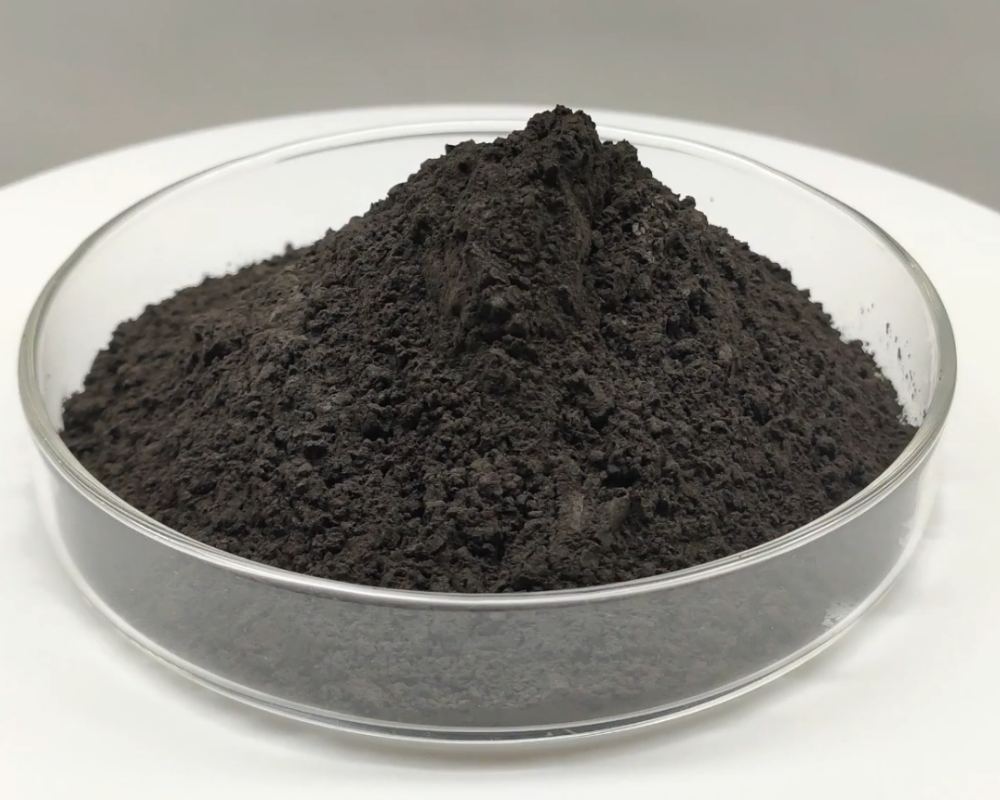
Chromite (FeCr₂O₄) has an extremely high melting point (≈2180°C). Soda-lime glass for bottles melts at only 1400–1550°C. It does not fully melt; instead, Cr³⁺ ions dissolve out for coloration. Oversized particles retain solid chromite spinel, resulting in black spots or stones.
1. Excessive particle size of raw chromite powder (most common primary cause)
- Presence of coarse particles >100μm: Only the surface of particles reacts slightly, while the inner core fails to dissociate. Residual solid chromite spinel grains form visible hard black spots. Unreacted chromite nuclei can be observed under microscope after sectioning.
- For typical beer-green bottles, 325 mesh (≤45μm) is recommended. At minimum, 200 mesh full pass (≤74μm) is required. Excessive sieve residue in coarse powder or agglomerates will cause massive black spots.
- Powder agglomeration: Moisture-induced lumps cannot be broken up during batching mixing, forming “pseudo-coarse particles” locally and also creating black spots.
2. Poor homogeneity of batch mix and local enrichment
The addition rate of chromite powder is low (generally 0.2–0.6%). Insufficient mixing time, low-efficiency mixer or stratification caused by large specific gravity difference among raw materials leads to local concentration of chromite powder. Overlapped particles cannot dissociate during melting and produce black spots or dark patches.
3. Inadequate melting process
- Low furnace temperature or insufficient melting time for batch pile: The lower layer of batch melts quickly while the upper layer has short residence time. Chromite fails to dissociate sufficiently. Insufficient temperature at outlet and forehearth carries undissolved particles into forming process.
- Reducing atmosphere: Oxygen shortage inside furnace or excessive carbon powder creates strong local reduction. It changes color and precipitates metallic iron and low-valence chromium to form metallic black spots. Oxidizing atmosphere must be maintained for chromite coloration; small amount of sodium nitrate can be added as oxidizer.
- Inadequate glass convection and stirring: Undissolved particles lack sufficient time to be eroded and dissolved by molten glass.
4. Foreign black spots introduced by impurities
- High-melting impurities naturally associated with chromite powder: coarse gangue, magnetite, metallic iron filings and heavy mineral impurities also form black spots. Control SiO₂, CaO and elemental iron impurities in chromite powder.
- Spalling of furnace refractory: Chips from chrome-magnesia brick and refractory entering molten glass. Microscopic features of such black spots differ from chromite stones from raw materials; sectioning can tell them apart.
- Metals and refractory impurities brought in by recycled cullet.
Quick identification method
- Hard black spots remain after polishing → unmelted chromite spinel particles (particle size issue of chromite powder)
- Black spots accompanied by tiny bubbles and soft texture → mostly precipitated metallic iron caused by reducing atmosphere
- Sharp surge of black spots right after batch or ore powder change → priority check of sieve residue and particle size distribution of ore powder
Corresponding corrective actions
- Chromite powder: Adopt 325-mesh chromite powder specially for glass. Strictly control sieve residue, test particle size distribution and remove particles >100μm. Keep powder moisture-free and break up agglomerates.
- Batching: Extend mixing time to ensure homogeneity and avoid stratification.
- Melting: Stabilize furnace temperature and guarantee enough refining & holding time; maintain oxidizing atmosphere and avoid excessive carbon reductant.
- Pre-treat cullet for iron and impurity removal; regularly inspect furnace refractory spalling.