
Green colorants commonly used for beer bottles, beverage glass bottles and glass containers fall into two categories: natural green colorants and synthetic green colorants. Specifically, the most widely used varieties include chromite powder / chrome flour, chromium oxide green, iron-based green and copper oxide green.
Chromite Powder (Chrome Flour|Primary Material for Mass-Produced Beer Bottles)
In terms of composition: Its main component is FeCr₂O₄, with available Cr₂O₃ content ranging from 40–46% (glass grade products preferably reach ≥46%).
For color tone: It presents olive green, deadleaf green, yellowish green and Georgia green hues.
In terms of product features: It boasts the best cost performance. Meanwhile, it is a mainstream product supplied by both domestic manufacturers and South African importers, thus becoming the most commonly used colorant for beer bottles and wine bottles.
Its standard particle size is 325 mesh (45 μm).
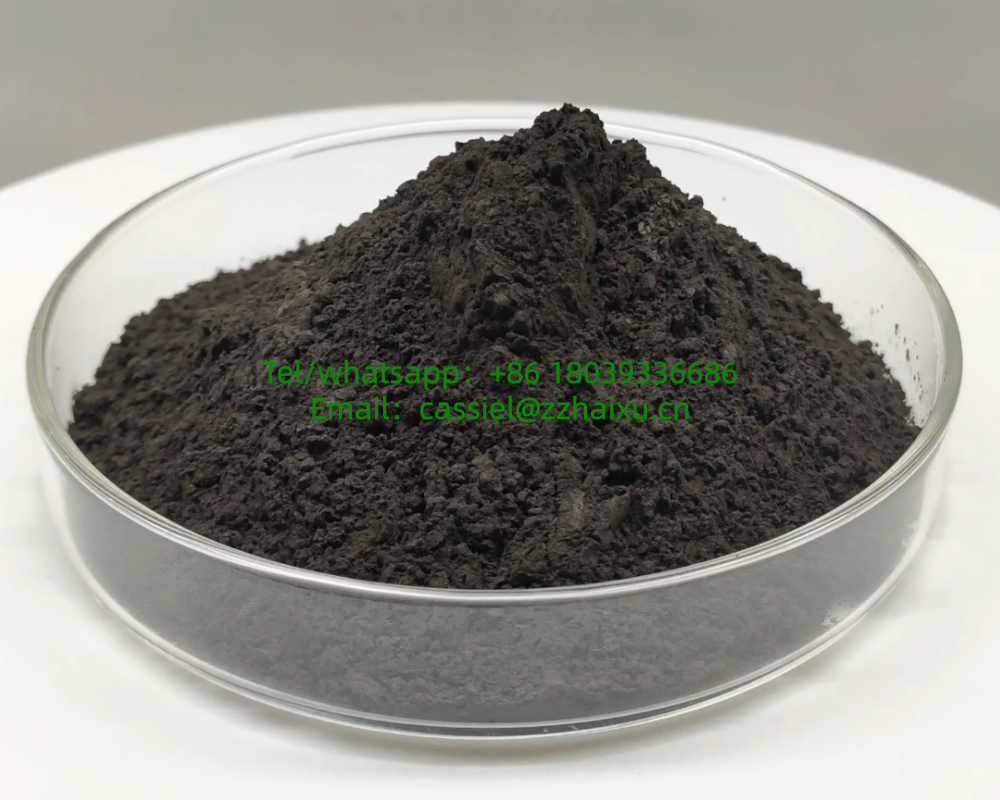
Chromium Oxide Green Cr₂O₃ (Synthetic Chromium Oxide|Emerald / Art Glass)
This product is pure chromium sesquioxide, with Cr₂O₃ purity of ≥98%.
Differently, it delivers a pure emerald green tone with clean and bright color development.
In terms of characteristics and application: It is priced higher but features strong tinting strength. Therefore, it is mainly applied to high-grade tableware, art glass and optical filters, and is rarely used alone for ordinary beer bottles.
Iron-Based Green (Ferrous Oxide FeO / Iron Oxide, Natural Green)
Under a reducing atmosphere, Fe²⁺ generates a blue-green color; additionally, the combination of ferrous and ferric iron forms a pale olive green tone.
In fact, many ordinary light green bottles obtain their natural tint from iron impurities contained in silica sand without the addition of chromite materials. This colorant has the lowest cost but comes with a dull yellowish undertone.
Its main drawback is that the color is unstable, making it impossible to produce vivid emerald green effects.
Copper Oxide Green (CuO / Cu₂O|Blue-Green / Turquoise Green)
It shows light blue-green and turquoise green under an oxidizing atmosphere; by contrast, it may turn reddish in a reducing atmosphere.
Due to its color variability, it is mainly used for decorative and craft glass, and is seldom adopted for the mass production of beer bottles.
Application Summary
In conclusion, different green colorants correspond to distinct glass product scenarios:
Standard green beer bottles generally adopt glass-grade chromite flour with 46% Cr₂O₃, which is the most common matching scheme;
high-grade emerald craft glass selects chromium oxide green Cr₂O₃;
low-cost pale light green bottles rely on natural green pigment formed by iron impurities in raw sand without chromite addition.