
Most commercially available olive-green beer/wine glass bottles are melt-produced with Grade 46 glass-grade chromite ore powder (FeCr₂O₄) as the primary colorant.
Chromite ore powder contains Fe₂O₃ in its main components, which suppresses bright green hues and yields a soft olive tone.
1|Coloring Mechanism
The effective color-forming constituent in chromite ore powder is Cr³⁺. It develops stable color under weakly oxidizing atmosphere during the melting of soda-lime glass at 1400–1550 °C, absorbing ultraviolet and blue-violet light. Its inherent iron oxides naturally produce olive green (not bright emerald green).
Standard dosage for conventional olive-green beverage bottles: 1.0–1.8 wt% of total batch weight
Light olive / yellowish-green shade: 0.3–0.8 wt%
2|Specification Requirements for Glass-Grade Chromite Ore Powder
South African ore is preferred. Recommended specifications:
Cr₂O₃ ≥46%
SiO₂ ≤3% (high silica causes white specks and devitrification)
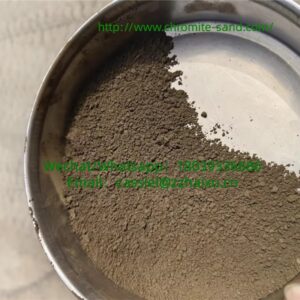
Particle size: 325 mesh / 45 μm, 100% passing.
3|Chromite Ore Powder vs Synthetic Chromium Oxide Green (Two Alternatives)
- Chromite ore powder (preferred for mass production of olive-green bottles): Native iron delivers natural olive / dull leaf-green tone; cost-effective; inherent UV blocking property. Limitation: fixed shade, cannot produce clean bright emerald green.
4|Critical Reminders for Food-Contact Containers
- Strictly restrain hexavalent chromium (Cr⁶⁺) formation during melting (excess oxidation or abnormal alkalinity promotes Cr⁶⁺ generation).
- Conduct leaching tests per national standards for food-contact glass to ensure chromium leaching meets compliance limits.
5|Troubleshooting & Color Tuning Tips
- Yellowish olive tone: slightly reduce chromite ore powder dosage or moderately raise oxidizing potential.
- Over-dark, ink-green shade: lower chromite ore powder loading.
- Cooler olive tone: blend with a tiny fraction of synthetic chromium oxide green (do not overdose).
Quick Selection Guide
For mass production of standard olive-green light-blocking bottles for beverages or essential oils → Use 46% glass-grade chromite ore powder, 325 mesh.