
Chromite powder for glass colorant is a natural inorganic mineral colorant processed and ground from South‑African chromite ore. It is mainly used for bulk coloring of soda‑lime‑silica glass. As a substitute for expensive synthetic chromium‑oxide green, it is widely applied in mass production of green glass bottles and green flat glass, serving as the mainstream green color‑forming raw material for beer bottles and beverage bottles.
Coloring Mechanism: Inside the melting furnace at 1400‑1550 ℃, the mineral decomposes to produce Cr³⁺ (trivalent chromium ions). It absorbs ultraviolet and violet light and reflects green light to form olive green, beer green and dark green. Iron contained in the ore assists color adjustment. An oxidizing atmosphere shall be maintained in the furnace to avoid blue tint and hazy defects caused by Cr²⁺ formation.
Dosage: 0.1‑2% calculated as Cr₂O₃, adjustable according to target color depth.
Core Advantages: High temperature resistance, stable color without fading, UV‑blocking performance to extend beverage shelf life. Its cost is far lower than synthetic chromium‑oxide green, suitable for mass production of float glass and container glass.
2. General Foreign‑Trade Technical Specifications (Glass Grade, 46% Grade)
| Item | Guaranteed Value |
|---|---|
| Cr₂O₃ | ≥46.0 % |
| SiO₂ | ≤1.0 % |
| FeO+Fe₂O₃ | 26‑28 % |
| CaO | ≤0.30 % |
| Acid Consumption Value | ≤2 ml |
| Moisture | ≤0.1 % |
| Mud Content | ≤0.1 % |
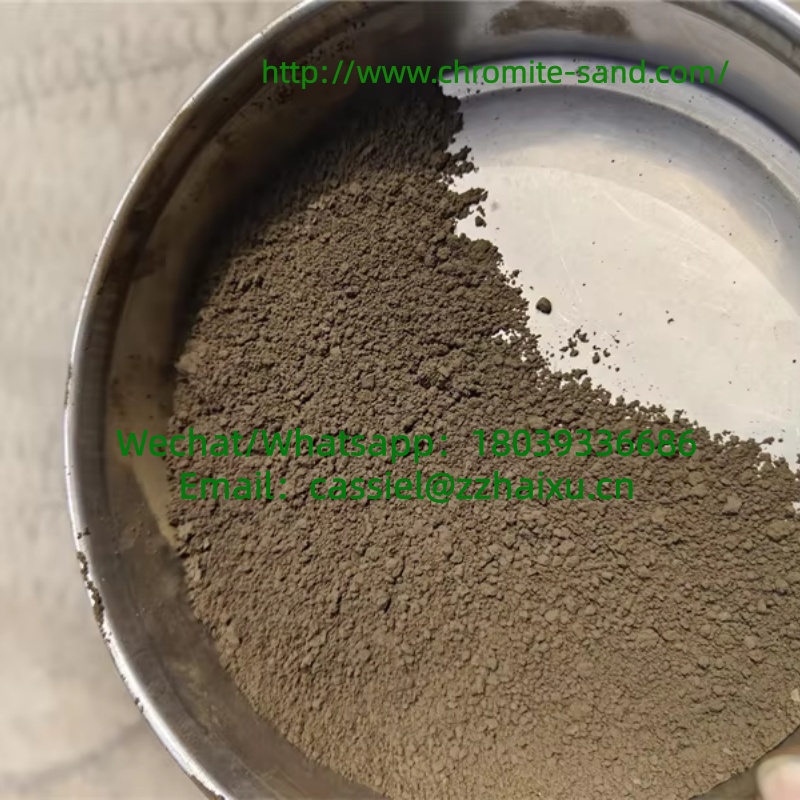
| Appearance | Dark‑brown Powder |
| Mohs Hardness | 5.5‑6 |
| Melting Point | ≈2150 ℃ |
Impurity Control: Magnetic impurities are removed by magnetic separation to prevent black spots and pitting on glass bottles. Oversized particles are strictly controlled, since coarse particles may lead to incomplete melting, color spots and stripe defects.
3. Common Particle‑size Grades and Selection Guide
| Mesh Size | Max Particle Size | Application Scenarios |
|---|---|---|
| 200 Mesh | ≤75 μm | Cost‑effective mass production for ordinary beer bottles |
| 325 Mesh | ≤45 μm | Industry mainstream grade with uniform dispersion and no mottling; for most beverage bottles |
| 400 Mesh | ≤38 μm | Mid‑to‑high‑grade wine bottles |
| 600‑800 Mesh | ≤23‑18 μm | High‑end decorative glass for fine translucent green tone |
For export orders: 325 Mesh is the most popular grade with 100% passing sieve requirement. D50 particle‑size test report (COA) can be provided.
4. Main Applications
- Container Glass: Beer bottles, wine bottles, beverage bottles and essential‑oil bottles to produce olive green, emerald green and tea‑green glass. Amber and brown glass bottles can be obtained with manganese / iron additives.
- Flat Glass: Coloring for architectural green flat glass.
- Ceramic Glaze: Green pigment for glaze surface.
Additional Function: Blocks ultraviolet rays to protect bottled drinks and retard deterioration.
5. Key Production Process Points
Dry‑mix directly with glass raw materials such as quartz sand, soda ash and limestone before feeding into the melting furnace.
Melting temperature: 1400‑1550 ℃. Maintain oxidizing atmosphere; a small amount of sodium nitrate may be added.
Finer particles bring faster melting and more uniform color. Coarse powder tends to cause black spots and color‑stripe defects.