
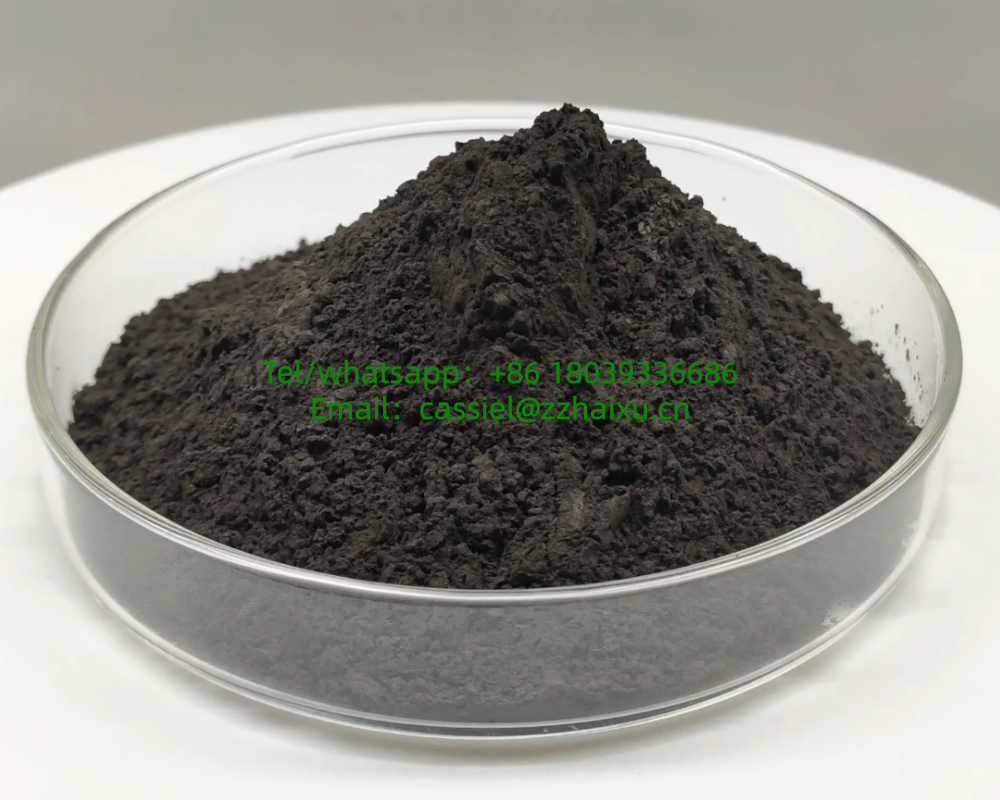
The main component of iron chromite flour is Cr₂O₃. Chromite powder colors glass mainly through chromium sesquioxide (Cr₂O₃). Under the high‑temperature melting condition of glass production, chromium exists stably in the form of trivalent chromium ions (Cr³⁺). Trivalent chromium ions selectively absorb visible light: they absorb blue‑violet light bands and transmit green light waves, endowing glass with characteristic green color, namely the olive‑green commonly seen in beer bottles.
Common particle‑size grades for glass coloring of iron chromite flour: 200 mesh, 325 mesh, 400 mesh, 600 mesh, 800 mesh, 1000 mesh, 1200 mesh, 1500 mesh, 2000 mesh, 2500 mesh.
- Color determined by chromium valence state Under the oxidizing atmosphere inside the melting furnace, chromium in chromite powder remains as trivalent chromium (Cr³⁺) to produce green color. Excessively reducing furnace atmosphere will generate divalent chromium and result in darker tone. If hexavalent chromium forms, the glass will turn yellow and fail to obtain pure green shade.
- Difference between natural chromite powder and synthetic chromium oxide green South‑African‑origin chromite powder for glass coloring is a natural mineral. Besides Cr₂O₃, it contains associated oxides of iron, magnesium and aluminum. Iron ions assist in color adjustment to form the classic dark olive‑green of beer bottles. Synthetic chromium oxide green delivers brighter color but comes at a higher cost.
- Color depth affected by dosage For 325‑mesh glass‑grade chromite powder, the typical addition ratio for ordinary beer bottles ranges from 0.3% to 0.8%. Higher dosage yields deeper green color. Finer particle size enables more uniform dispersion in molten glass, lowering risks of black spots, particle inclusions and slag defects.
- Process constraints Melting temperature and oxidizing atmosphere are critical parameters. Insufficient melting temperature causes incomplete fusion of chromite mineral particles, leading to black spots and sand‑grain defects. Poor oxidizing atmosphere will produce greyish tint and large color deviation.