
What grades of chromite flour are used for foundry coatings?
Raw material: South‑African chromite ore. Cr₂O₃ ≥46%, SiO₂ ≤1.0% (critical index, different from glass‑coloring grade).
Particle Size Selection
| Model | Particle Size | Application Process & Castings |
|---|---|---|
| 200# | 0‑75 μm | Brushing & dipping application; large heavy‑section steel castings, gears, ingot moulds. Most cost‑effective general grade for water‑based coatings. |
| 325# | 0‑45 μm | Mainly for spraying; manganese steel, stainless steel, alloy steel castings; lost‑foam coating. Most widely‑used grade in domestic foundries. |
| 400# | 0‑38 μm | Precision & thin‑wall steel castings; fine smooth coating with good levelling property, compatible with both water‑based and alcohol‑based systems. |
| 500# / 600# | Ultra‑fine | High‑end precision castings for superior surface finish; better suspension performance with higher cost. |
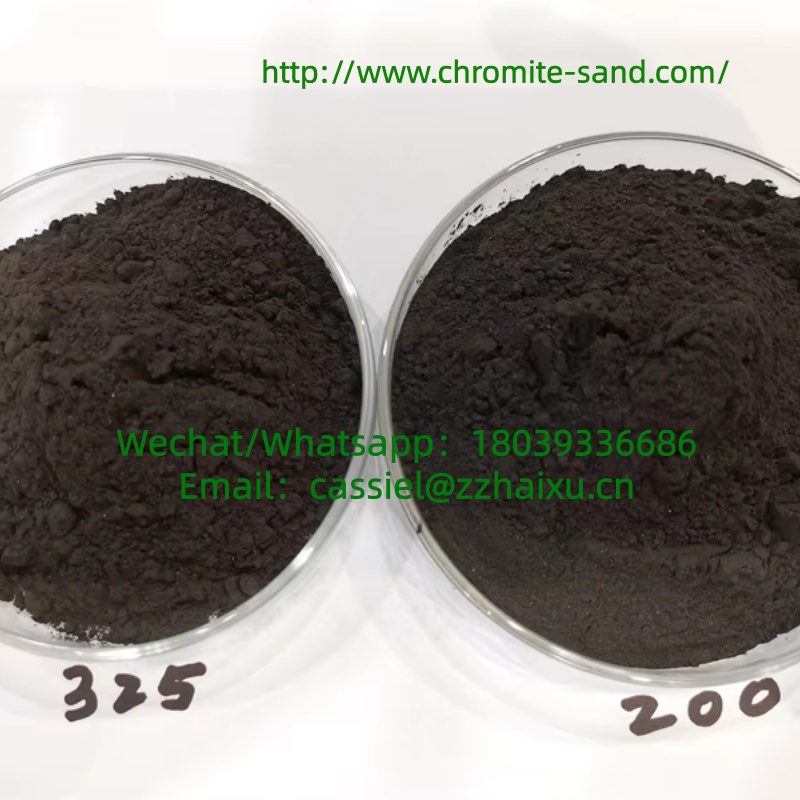
Popular purchasing grades of chromite sand: 325# and 200#. Choose 325# for spraying; choose 200# for brushing/dipping; select 400# for high‑end formulations.
Avoid 800# and finer powders for standard foundry coatings. Excessive specific surface area causes high water demand, coating swelling and cracking.
Key Chemical Specifications for Foundry‑Grade Chromite Flour
| Item | Specification |
|---|---|
| Cr₂O₃ | ≥46.0 % |
| SiO₂ | ≤1.0 % (strict control, high silica causes coating erosion) |
| CaO | ≤0.30 % (prevent coating blistering & cracking) |
| P, S | ≤0.003% (avoid casting porosity defects) |
| Moisture | ≤0.1% |
Foundry‑Grade vs Glass‑Coloring Grade Chromite Flour
- Foundry coating grade: Strict SiO₂ control ≤1.0%, particle sizes 200‑400#, focused on refractoriness and anti‑burn‑on performance.
- Glass‑coloring grade: Loose SiO₂ requirement, optimized for tinting performance. Not suitable for foundry coatings.
Short description for PI / TDS
Foundry‑grade Iron Chromite Flour, 200#, 325#, 400#. Cr₂O₃ ≥46%, SiO₂ ≤1.0%. Serves as main refractory aggregate for water‑based and alcohol‑based steel casting coatings.